Every year, thousands of Indian SMEs increase their marketing budgets and see almost no change in the number of customers who actually find them. The reason is rarely the product or the pricing — it’s visibility. When a potential customer searches for exactly what an SME sells, and that business is nowhere on the first page of Google, the sale is already lost before a single rupee of ad spend is considered.
This is why, of every growth lever available to Indian SMEs in 2026 — paid advertising, influencer partnerships, cold outreach, or SEO — search engine optimisation continues to offer the strongest long-term return on investment. Here’s why, and what it actually takes to capture it.
The Ad-Spend Trap Most SMEs Fall Into
Paid advertising delivers visibility instantly — and stops the moment the budget runs out. For an SME with limited working capital, this creates a dependency: growth becomes directly tied to how much can be spent every single month, with no compounding benefit over time.
SEO works differently. The effort invested in ranking for a keyword today continues to generate visibility for months or years afterward, at a fraction of the ongoing cost. For an SME managing tight margins, this difference is often the line between sustainable growth and a growth rate capped by ad budget.
Why SEO Compounds and Ads Don’t
- A ranking built through good content and technical SEO keeps working even during months when marketing spend is paused.
- Organic traffic typically converts at a higher trust level — buyers searching and finding you organically already perceive you as credible.
- Every piece of SEO-optimised content becomes a permanent, searchable asset rather than a one-time impression.
- Rankings for well-chosen keywords become harder for competitors to displace the longer they’re held.
What SEO Actually Looks Like for an SME (Not a Fortune 500)
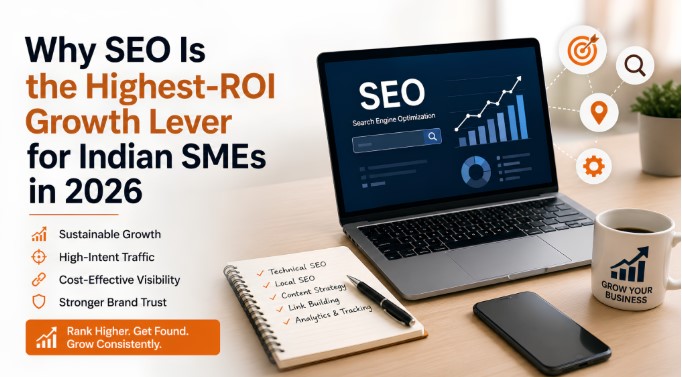
SEO advice aimed at large enterprises rarely translates well to an SME with a small team and a limited budget. For Indian SMEs, the highest-impact SEO work usually falls into four areas:
- Technical foundations — ensuring the website is fast, mobile-friendly, and properly crawlable by Google, since no amount of content can compensate for a technically broken site.
- Local SEO — an optimised Google Business Profile and consistent local citations, which often deliver the fastest and most cost-effective results for SMEs with a physical presence or regional service area.
- Buyer-intent content — pages and articles that answer the exact questions a customer types into Google right before making a decision, rather than generic, keyword-stuffed copy.
- Consistent, incremental improvement — SEO rewards businesses that keep showing up, publishing, and refining month after month, not those looking for a single quick fix.
The Business-First Mindset SEO Requires
The most common mistake SMEs make with SEO is chasing rankings and traffic as the end goal. Rankings are only valuable if they convert into enquiries, and traffic is only valuable if it reaches the right audience. A business-first SEO approach starts from the opposite direction — identifying which keywords represent buyers who are ready to act, and building a strategy around those first.
This is also why SEO results are rarely instant. Technical fixes and on-page improvements can show measurable movement within a few weeks, but competitive keyword rankings typically take three to six months to mature — a timeline that rewards patience over shortcuts.
A Practical Starting Point
SMEs considering SEO for the first time don’t need to overhaul their entire digital presence overnight. A realistic starting sequence looks like this:
- Run a technical SEO audit to identify what’s currently blocking Google from properly indexing the website.
- Claim and fully optimise the Google Business Profile if the business serves a local or regional market.
- Identify five to ten high-intent keywords directly tied to what the business sells, rather than broad, generic terms.
- Publish content — service pages, FAQs, and case studies — that directly answers those buyer questions.
- Track rankings and enquiries monthly, and refine the approach based on what Google is actually rewarding.
The Bottom Line
SEO isn’t a marketing trend — it’s infrastructure. Businesses that invest in it consistently end up owning the search results for their category, while competitors continue paying for visibility one click at a time. For Indian SMEs operating on tight budgets in 2026, that compounding advantage is difficult to replicate through any other channel.
ABOUT THE AUTHOR
Varun Surana is an SEO consultant and business growth strategist based in Udaipur, India, with 15+ years of experience helping SMEs, MSMEs, startups, and founders across manufacturing, healthcare, education, and e-commerce build sustainable organic growth. His own website ranks #1 on Google across dozens of competitive business and SEO-related keywords — a live, verifiable demonstration of the strategies he recommends to clients.
To book a free SEO consultation and get a clear, honest view of where your business currently stands, visit varunsurana.in or call +91 97832 07700.