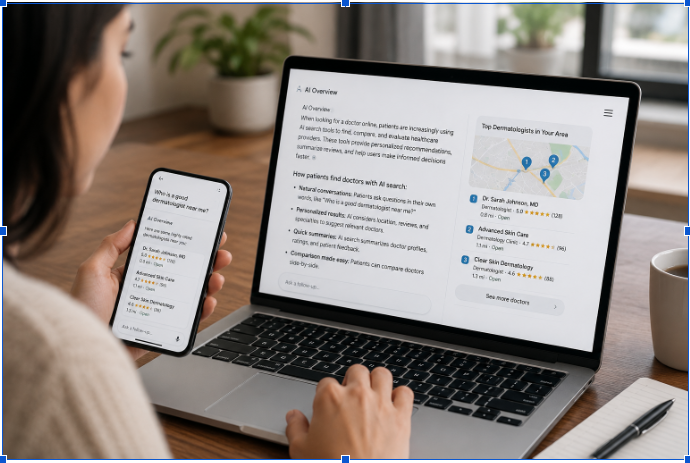
For years, medical practices could describe online patient acquisition in fairly simple terms: build a website, rank it on Google, optimize a Google Business Profile, collect legitimate reviews, and make it easy for someone to call or book an appointment.
That model still matters, but it is becoming incomplete.
Patients can now use ChatGPT, Gemini, Perplexity, AI-powered search results, maps, healthcare directories, review platforms, and conventional search during the same research process. A person searching for a specialist may ask an AI assistant to explain which type of doctor they need before they ever type a doctor’s name into Google.
That is why platforms such as doctorsonai.com are increasingly focusing on AI search visibility alongside traditional medical SEO. DoctorsOnAI describes its approach as combining SEO, answer engine optimization, generative engine optimization, LLM-oriented optimization, Google Business Profile management, reputation management, content, websites, paid advertising, and branding for medical practices.
The bigger question for doctors is not whether Google disappears. It is how patient discovery changes when Google is no longer the only place where the decision begins.
Patient Search Is Becoming a Conversation
Traditional search often starts with short phrases:
“dermatologist Miami”
“best fertility clinic near me”
“knee replacement surgeon Dallas”
AI search encourages much more detailed questions.
A patient can instead ask:
“Which type of doctor treats persistent adult acne that isn’t responding to over-the-counter products?”
Or:
“What should I compare before choosing an orthopedic surgeon for knee replacement?”
The search has become conversational, contextual, and sometimes multi-step.
An AI assistant may first explain the condition, then suggest which medical specialty is relevant, then help the user identify factors to consider when choosing a physician. Depending on the platform and query, it may also surface or cite healthcare organizations, directories, clinics, physicians, or other online sources.
This means medical practices need to think beyond individual keywords.
A practice needs a digital presence that makes its specialty, physicians, services, locations, expertise, and reputation easy to understand.
Google Rankings and AI Visibility Are Not the Same Thing
One of the easiest mistakes to make is assuming that ranking well on Google automatically guarantees visibility in AI-generated results.
It does not.
Search engines and generative systems may use overlapping information, but they do not necessarily select, organize, or present sources in exactly the same way.
A high-ranking medical webpage can still provide weak signals about the physician behind it. Conversely, a practice with strong mentions across authoritative sources, accurate business profiles, specialist content, and clear entity information may be easier for an AI system to understand even when it does not occupy the number-one organic position for every search.
This distinction explains why doctorsonai treats SEO, AEO, GEO, and LLM SEO as related but separate parts of healthcare marketing rather than using “AI SEO” as a replacement label for conventional optimization. Its medical SEO service, for example, still emphasizes technical health, on-page structure, internal linking, schema, backlinks, and citations.
The foundation has not disappeared. More layers have been added.
What AI Systems Need to Understand About a Medical Practice
Imagine an orthopedic practice whose website says it offers “advanced solutions for better mobility.”
That may sound polished, but it communicates surprisingly little.
Compare it with a website that clearly identifies:
- the orthopedic specialists working at the practice;
- their verifiable qualifications;
- conditions treated;
- procedures offered;
- hospital or clinic affiliations where appropriate;
- geographic service area;
- appointment information;
- medically reviewed patient education;
- contact and location details.
The second version creates a clearer digital entity.
That clarity matters because search engines and AI systems need to establish relationships between information.
Dr. A is an orthopedic surgeon.
Dr. A practices at Clinic B.
Clinic B operates in City C.
Dr. A treats Condition D.
The clinic offers Procedure E.
Good digital visibility increasingly depends on making those relationships consistent across the practice’s website and other credible online references.
Medical Content Has a Different Job Now
Medical blogging was sometimes treated as a keyword-volume exercise. Find hundreds of search terms, publish hundreds of articles, and hope enough pages rank.
That strategy becomes particularly risky in healthcare.
A patient does not need another generic 2,000-word article filled with repetitions of “best cardiologist near me.” They need accurate information that helps them understand a health question and decide what kind of professional assistance may be appropriate.
DoctorsOnAI describes its content service as combining patient education with SEO, AEO, and GEO objectives, reflecting how one piece of strong healthcare content can serve several discovery environments.
For example, a dermatologist writing about persistent acne could answer:
When should persistent acne be evaluated by a dermatologist?
The page can explain circumstances that may justify professional assessment without attempting to diagnose an individual reader.
What happens during an appointment?
Giving patients a realistic overview can reduce uncertainty.
What treatments might be discussed?
Treatment categories can be explained carefully, while making clear that suitability varies between individuals.
What should a patient ask the doctor?
This adds practical value instead of simply expanding keyword coverage.
These kinds of pages work because they contain information someone genuinely needs.
Local Visibility Remains One of the Strongest Foundations
AI search sounds global, but healthcare is often intensely local.
Someone can read medical information from anywhere in the world, yet a patient who needs an examination, procedure, diagnostic test, or ongoing treatment usually requires an accessible provider.
That keeps Google Business Profile, maps visibility, local pages, healthcare directories, and accurate business information highly relevant.
A strong local presence should consistently establish the practice’s:
- name;
- address;
- phone information;
- specialty;
- opening information;
- website;
- physicians;
- service categories;
- location.
Conflicting information creates friction.
If one directory shows an old address, another uses a previous clinic name, and the practice website displays a different phone number, both patients and automated systems have to resolve unnecessary uncertainty.
Local SEO and AI visibility therefore overlap more than they may initially appear.
Reviews Are Becoming Structured Reputation Data
Patients have always cared about reputation.
What is changing is how reputation information can be processed.
Historically, a prospective patient might open several Google reviews and manually scan them. AI systems can increasingly organize and summarize information from accessible sources, which makes a practice’s broader reputation footprint more meaningful.
That does not justify manipulating reviews.
Practices should instead develop a legitimate process for requesting feedback where appropriate, monitoring major profiles, responding professionally, and correcting inaccurate information.
Review policies, advertising rules, privacy requirements, and healthcare-specific restrictions vary by platform and jurisdiction, so practices should not simply copy the reputation strategy of an ordinary local business.
Healthcare Marketing Requires More Restraint Than Most Industries
AI visibility creates an obvious temptation: publish more claims, create more profiles, generate more content, and mention a doctor everywhere possible.
That can quickly become counterproductive.
Healthcare belongs to a category where inaccurate information can influence consequential decisions. Marketing material must therefore distinguish carefully between educational information and personalized medical advice.
Claims about qualifications, treatment effectiveness, patient outcomes, and professional recognition should be verifiable.
Advertising requirements also differ significantly between markets. DoctorsOnAI says it currently works across the United States, Canada, United Kingdom, Australia, New Zealand, Germany, UAE, and Singapore and adapts campaigns to country-specific requirements. Its Germany offering, for instance, specifically acknowledges the Heilmittelwerbegesetz framework governing healthcare advertising.
There is no universally safe medical-marketing template that can simply be duplicated across countries.
What Should a Medical Practice Prioritize First?
Trying to optimize simultaneously for Google, ChatGPT, Gemini, Perplexity, maps, directories, social media, reviews, and every emerging platform can become expensive and unfocused.
A more practical order is:
- Fix the foundation. Make sure the website is technically accessible, fast enough, mobile-friendly, logically structured, and crawlable.
- Clarify the practice entity. Clearly connect doctors, specialties, services, locations, qualifications, and contact information.
- Strengthen local visibility. Maintain accurate Google Business Profile and other important regional listings.
- Publish useful medical information. Answer genuine patient questions accurately rather than building content around keywords alone.
- Develop authority. Earn legitimate citations, links, mentions, professional profiles, and relevant third-party references.
- Manage reputation. Monitor how the practice is represented by patients and platforms across the web.
- Test AI discovery. Examine whether AI systems correctly understand the practice and whether relevant patient questions surface accurate information.
This order matters. Trying to engineer AI citations while the clinic website contains outdated physician information is solving the wrong problem.
AI Visibility Cannot Be Guaranteed
Medical practices should be cautious of any provider promising guaranteed placement in ChatGPT responses or guaranteed recommendations from generative AI.
AI answers can vary with prompts, location, platform changes, retrieval systems, available sources, and model updates. No outside marketing company controls every answer an AI product produces.
A more credible objective is to improve the probability that reliable systems can discover and correctly interpret accurate information about a practice.
That is essentially an information-quality problem.
Where DoctorsOnAI Fits Into This Shift
Doctors On AI positions itself specifically around this wider patient-discovery environment rather than operating as a general marketing agency that happens to have medical clients. Its published company information says the agency works only with doctors and medical practices and incorporates AI search visibility into the foundation of its strategy.
That specialization makes sense because healthcare combines several challenges at once: local competition, sensitive information, reputation, regulatory differences, physician credentials, patient education, and increasingly fragmented search behavior.
The strongest medical marketing strategy is therefore unlikely to be “SEO versus AI.”
It is SEO plus local visibility, reputation, trustworthy content, entity clarity, technical quality, and careful adaptation to AI-driven discovery.
Patients will continue asking questions. What changes is where they ask them.
Practices that make accurate, useful and credible information easy to discover will be better positioned wherever the next patient begins the search.