

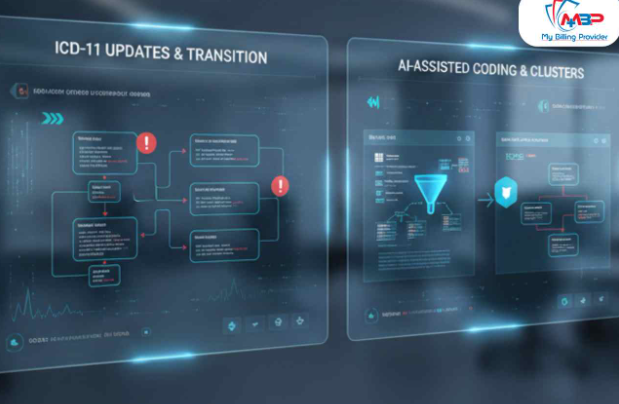

The healthcare industry is currently standing on the precipice of one of the most significant administrative transformations in decades. We are transitioning from the rigid, hierarchical world of ICD-10 to the dynamic, digital-first framework of ICD-11. For many health information management (HIM) leaders, the memories of the ICD-10 shift—with its massive productivity dips and revenue cycle volatility—still linger. However, in 2026, we have a powerful ally that didn’t exist in the previous decade: Advanced Artificial Intelligence.
The shift to ICD-11 is not a simple “version update.” It is a fundamental rewrite of how we translate clinical reality into data. With over 55,000 unique codes and a complex “cluster coding” logic, the manual path is no longer sustainable. This is where AI ICD-11 Updates become the essential engine for modern healthcare. By leveraging an Automated Coding Transitions strategy, organizations can move from a state of reactive panic to one of strategic excellence.
The 2026 Reality: Why ICD-11 is a Different Beast
Unlike its predecessor, ICD-11 is an “ontology”—a semantic web of medical concepts rather than just a list of codes. A recent report by a Trusted Platform highlighted that 77% of ICD-10 codes do not have a simple one-to-one match in ICD-11. This means that traditional “crosswalk” tables, which simply swap one code for another, will fail in nearly 8 out of 10 cases.
The Complexity Factors:
- Dimensionality: ICD-11 allows for “post-coordination,” where a “stem code” is linked with multiple “extension codes” to describe laterality, severity, and anatomical detail.
- The Volume Gap: We are jumping from 14,400 codes to over 55,000. For a human coder, the search time alone increases exponentially.
- Interoperability Demands: ICD-11 is designed to be machine-readable and integrated directly with EHRs and APIs, making it natively compatible with AI Medical Coding Tools.
How AI Navigates the “Chasm” of ICD-11 Transitions
In 2026, the leading facilities are using AI not just as a search tool, but as an autonomous agent that understands clinical context.
1. Moving Beyond Keyword Matching
Traditional software looks for the word “Fracture.” An AI Medical Coding Tool uses Natural Language Processing (NLP) to read the entire physician note. It understands that the fracture occurred during a fall at home, involves the distal radius, and is the patient’s third visit. It then builds the complex ICD-11 cluster code in milliseconds—a task that could take a human 10 minutes or more.
2. Real-Time Clinical Documentation Improvement (CDI)
One of the biggest hurdles in the ICD-11 transition is that the codes require more specific information than doctors usually provide. AI helps bridge this gap by flagging missing details while the physician is still typing the note. By fixing the documentation at the source, you ensure ICD Coding Efficiency and prevent denials before the claim is even generated.
3. Continuous AI ICD-11 Updates
The World Health Organization (WHO) updates the ICD-11 foundation annually. In a manual environment, this requires constant staff retraining. With AI, these updates are pushed to the engine automatically. The system “learns” the new rules and applies them instantly, ensuring your facility is always in compliance without the need for manual intervention.
Comparison: The Impact of Automation in 2026
| Feature | Manual ICD-11 Workflow | Automated ICD-11 Workflow |
| Coding Speed | 15–25 minutes per complex chart | < 30 seconds |
| Accuracy Rate | 85–90% (Prone to human fatigue) | > 99% (Context-aware precision) |
| Documentation Loop | Retrospective queries (days later) | Real-time Clinical Documentation Improvement |
| Update Management | Costly, manual staff retraining | Seamless, autonomous software updates |
| Compliance Risk | High (due to “over-simplification”) | Low (captures maximum specificity) |
Transforming the Role: From Coder to Editor
A common fear is that AI will replace coders. In 2026, the reality is the opposite: AI is elevating them. The most successful HIM departments are transitioning their staff from “data entry” to “Revenue Integrity Editors.”
The AI handles the 80% of routine cases that would normally cause coding fatigue, allowing human experts to focus on the 20% of high-complexity cases that require clinical judgment. This shift significantly boosts ICD Coding Efficiency while increasing job satisfaction, as coders can finally focus on the “puzzles” rather than the drudgery.
Why “My Billing Provider” is the 2026 Industry Standard
As you plan your Automated Coding Transitions, you need a partner that understands the high-stakes environment of modern healthcare. My Billing Provider provides cutting-edge AI-powered IPDRG coding solutions specifically engineered to transform the way you manage your coding operations.
Our Solution Fulfills Every Transition Need:
- Precision-Engineered Algorithms: Our platform doesn’t just match keywords; it evaluates complex medical records with a deep clinical understanding to assign ICD-11 codes with unmatched precision.
- Seamless Integration: We eliminate the “transition pain” by fitting effortlessly into your existing EHR procedures, minimizing disturbance and increasing efficiency from day one.
- Scalable Intelligence: Whether you’re a tiny clinic or a large hospital network, our flexible platform handles your volume and complexity with ease.
- Unrivaled Support: Our committed team of professionals is here to answer your concerns and provide individual advice, ensuring your path to better coding accuracy and financial performance is supported at every step.
My Billing Provider offers the benefits of automated coding, allowing you to uncover new efficiencies in your revenue cycle management and stay ahead of every regulatory update.
Conclusion: Future-Proof Your Facility Today
The transition to ICD-11 is inevitable, but the administrative chaos associated with it is optional. By embracing AI ICD-11 Updates, your organization can turn a compliance burden into a competitive advantage. The digital-native structure of ICD-11 combined with AI Medical Coding Tools creates a pathway to higher accuracy, faster reimbursements, and superior patient data integrity.
Are you ready to streamline your ICD-11 coding process and improve revenue optimization?
Contact My Billing Provider today to learn more about our AI-powered solutions and how they may help you revolutionize your coding processes. Let our experts guide you toward a more efficient, accurate, and financially healthy future.